
Apples in Our Kitchen Garden
In our kitchen garden we have two espaliered apple trees that are nearly twenty years old. I planted them myself when we finished building our home. For all those years, our little family has had delicious, sweet, juicy red apples to enjoy. Sadly, I never wrote down the names of the trees planted…all I know is they are Irish.
Apples have grown in Ireland for more than 3,000 years. It is said that St. Patrick planted apple trees and famously planted one at Ceangoba, an ancient settlement east of Armagh. Early monastic records show that monks ate apples with their meals and Brehon Laws (dating back 1,000-2,000BC) stated clearly that cutting down an apple tree was a crime.
Today the oldest apple variety still commercially grown in Ireland is the Bramley. It’s about 200 years old. It is the one we most often use for cooking: its tartness makes it an ideal choice for baking and its size makes it easy to work with. As good as it is, however, there are other apples in Ireland worth knowing.
In 2002 a group of Irish apple growers got together and started Celtic Orchards. Their goal is to provide the local economy with the best Irish grown apples. They grow Red Windsor, Red Elstar, Jonagored, Red Prince and about twenty other types.

Buttermilk Russet Apple
In the early 90’s, the Irish Seed Savers Association started searching for the last surviving traditional Irish varieties of apples and identified over 140 types that are still growing around the country today. With names like Bloody Butcher, April Queen, Irish Peach and Peasgood Nonsuch, it’s quite entertaining to read through the list.
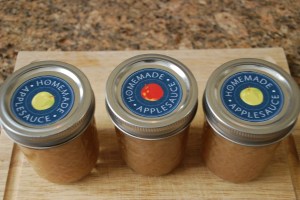
I wish our apples had clever names. Scratch that, I wish they just had names! Perhaps the thing to focus on is their taste. Our apples are delicious straight off the tree and they’re also good for juicing and making applesauce. At this time of year, I make a lot of both. My lovely my mother-in-law gave me her simple recipe for applesauce: apples, water and sugar – it’s that easy. This year I’ve taken the recipe one step further and added cinnamon. I’ve also started canning it.
What follows is Mama (pronounced like “Nana”) McGuire’s recipe and my instructions for canning. If you’re fortunate to have an apple tree growing in your garden or you see a well priced box of apples at the farmer’s market, I hope you’ll make your own applesauce. I guarantee that once you do, you’ll never see a need to buy it at the supermarket ever again. Enjoy!

Homemade Applesauce
Makes 5 Quarts
Ingredients
16-18 pounds apples
4 cups water
juice of 1 lemon
1/2-1 cup sugar, to taste
1-2 tablespoon ground cinnamon (optional)
Directions
1. Prepare canner and sterilize jars by immersing in boiling water for 15 minutes. Keep jars in hot water until ready to use. Warm lids in a second pot of gently boiling water to sterilize.
2. Peel, core and cut apples into small chunks, removing blemishes and bruises.
3. In a large pot, bring apples, water, lemon and sugar to a boil. Reduce heat to medium-low, cover, and cook until apples are soft or fall apart, whichever you prefer. Stir occasionally to prevent scorching. 
4. Once apples are soft, taste and add more sugar, if necessary. If you like your applesauce smooth, you may pass the cooked apples through a food mill or use an immersion blender or food processor at this point. Add cinnamon, if desired. Return applesauce to pot and keep hot. It’s important keep the applesauce hot.
5. Ladle applesauce into (hot) jars, leaving 1/2-inch of headspace. (Headspace is the space between the top of the applesauce and the top of the jar.) Do not overfill jars – leaving too little headspace may cause the applesauce to leak out of jars during processing and also when you remove the jars from the canner.
6. Slide a clean plastic knife along inside of jar to force air bubbles up and out of applesauce.
7. Carefully wipe the rim of jars with a clean cloth or kitchen roll (paper towel).
8. Take each lid out of the hot water and place it, rubber gasket side down, on each jar. Remove bands from the hot water and screw onto jars until fingertip-tight. Do not over tighten.
9. Carefully place jars in canner filled with hot water (also known as a “water bath”). Do not place more jars in canner than is appropriate – jars too close together may break during the processing.
10. Add more water, if necessary, to completely cover jars by at least 1-to-2-inches. Be sure to add more boiling water during the processing time to keep the jars covered.
11. Bring water temperature up to a rolling boil, cover pot and process for 20 minutes. If you are 1,000-3,000 feet above sea level, process for 25 minutes. If you are 3,000-6,000 feet above sea level, process for 30 minutes. If you are 6,000 to 8,000 feet above sea level, process for 35 minutes. And, if you are more than 8,000 feet above sea level, process for 40 minutes.
 12. When the processing time is up, lift jars carefully from canner and place on a clean tea towel on the counter. Leave to cool completely – 12 to 24 hours. You will hear lids make a popping sound as the centre lid gets sucked down by the contracting air in the jar and seals. This is a very satisfying sound.
12. Test the jar lids to make sure proper sealing took place by depressing the centre of the lids. If the centre of the lid moves up and down, the jar did not seal correctly. Any jars that have not sealed properly should be stored in the refrigerator and the contents should be eaten within 1-2 weeks.
13. Properly sealed jars should be stored in a cool, dark, place for up to one year.
Notes:
1. If applesauce leaks out of a jar during the processing or while being removed from canner, allow it to cool completely and then check seal carefully. If seal is intact, consume the contents of that jar first.
2. If there is liquid at the bottom of your jar after processing, don’t worry. This sometimes happens, just stir the contents of the jar when you open it.
 3. Follow processing time for your altitude.
4. If mold grows in the headspace of your sealed jar, do not eat the applesauce.
5. If the jar does not seal properly, refrigerate the jar and eat the applesauce within 1-2 weeks.
6. Cute labels for your jars may be found at: http://www.loveandoliveoil.com/2012/09/homemade-applesauce.html or http://www.according-to-kelly.com/2010/08/mason-jar-jam-labels/ and http://gardenofeatingblog.blogspot.com/2007/12/applesauce.html
Related Articles:
How to Make Applesauce (emmycooks.com)
Applesauce – or – “We’re never buying that again!” (smallworldsupperclub.wordpress.com)
An Appetite for Applesauce (wholefoodsmarket.com)
Read Full Post »
 It’s Halloween and the veil between the living and the dead is slowly drawing back! Tonight all across the land, ghosts and ghouls will roam freely.



 In an Irish Home