It’s been two weeks since Irish filmmaker Nick Ryan won the Sundance Film Festival Editing Award for a World Cinema Documentary for The Summit. The night before the award was announced, Nick spoke with me and photographer Michael Coles at length about the making of the film and the shocking tragedy that left eleven of twenty-four climbers dead or missing on K2 in August 2008.
You haven’t been asked much about your personal life but given I have many readers who live in or are from Ireland, I know they’ll be curious to know a bit about you. Where did you grow up? Many places in Dublin: I’d say Cornellscourt, Cabinteely, for most of my life. I also lived in Delgany, when I was a kid.

© 2013 Michael Coles
What about Secondary School and University…where did you go? I went to Blackrock College and then I went to Dun Laoghaire Art College, now Dun Laoghaire Institute of Art, Design & Technology. I studied graphic design there.
You went from graphic design to film? What happened there? Simply…I always made films but it didn’t seem, at the time, when I went to art college, a particularly good route to follow career-wise. There weren’t many real jobs back then for film makers in Ireland so I figured I’d go to art college and learn a trade. Graphic design was something I was always interested in and that was the career path I thought I’d take but I never really practiced graphic design. After college I went directly into computer graphic animation, then through to visual effects, commercials, music videos, and then short films.
This next question may not seem relevant but it will be later on. Are you married and have you a family? Yes, I’m married and no we don’t have children.
Now, we’re done with the personal stuff, let’s talk about The Summit. This is your first big film, isn’t it? Yes. It’s my first feature. There were two short films before The Summit – Blue Sky and The German. As I was finishing The German in 2008, this story (The Summit) was brought to me.
I read an article where you were referred to as a “freshman” filmmaker. How does that sit with you? Was this in a lovely Variety review, perhaps?

© 2013 Michael Coles
Yes… I take it you’re not amused! {laughter}
You have to admit, you’ve gone from doing two shorts films to making a really big film in The Summit. That’s an enormous leap, don’t you think? It’s not really. Well…I suppose it is and it isn’t. It’s an entirely different approach, without a shadow of a doubt. I tried to employ all the narrative skills I have to tell this story. I’ve always been a narrative story-teller and this one was just so big, hence the structure of the film and the way it is shot. It’s definitely a film for a big screen and not just a “television film”, if you know what I mean.
You worked with the writer Mark Monroe. Yes. Mark Monroe… he’s a very talented writer. He wrote a film called The Cove and also Who is Dayani Crystal which is here at Sundance. We worked very, very, hard on this film. It was such a complicated story to tell. Basically everyone had a story on the mountain and we tried to deal with the complexities of those stories but do so in a manor…without sounding crass because it was an event where many people were killed… that would keep people engaged the whole time.
The Summit could easily have been just another “talking head” documentary. Yes, it could have been but this is really a story about adventure and human tragedy and that fascinated me. I thought it worked better as a narrative rather than a {traditional} documentary.
Some say you’ve crossed a new boundary with The Summit into something that’s never been done well before in documentary film making. Critics have described it as “dynamic”, “irresistible” and “compulsively watchable”. We knew from the beginning there was archival footage from the mountain taken by Ger and the other climbers. But there was obviously some footage that was never taken. I wanted to recreate that without being sensational about it. In all there were quite a few sources. The reconstruction we shot in the Eiger, Switzerland and then there was the aerial photography on K2. And, of course there were the interviews. Robbie Ryan, my cousin, did the cinematography for the film and it is really amazing.
Your cousin? Well, yeah, he happens to be my cousin…but he also just happens to be one of the best cinematographers in the world. He’s shot all of Andrea Arnold’s movies.

© 2013 Michael Coles
So you and Robbie are related. Is that how you got him involved? No, no, no. Robbie shot my previous film, The German. And, he was the right fit for what I was trying to do on the mountain. Robbie’s style is very visceral and loose and he’s …you know… he’s just one of the best. It wasn’t nepotism. He didn’t “need” this gig, shall I say.
No, of course he didn’t. Emmh, no. He’s just one of the best and he also happens to be my cousin.
How did this film come to you? It started very soon after the actual events on the mountain. Pat Falvey, who was a friend of Ger’s, came to us. They had climbed together before and in 2003 they went to Everest and Pat’s life had been saved by Ger and Sherpa Pemba Gyalje. At the time of the accident, Pemba hadn’t gotten much recognition in the media for the amazing work he’d done on the mountain and the world wasn’t aware of anything Ger had done yet. And so, at first, we were really looking into that but then by December 2008, Pemba was on the cover of National Geographic and was named Adventurer of the Year so it was a little disingenuous to suggest that he wasn’t getting the recognition he deserved for his heroic deeds.
About that time the mystery surrounding Ger McDonnell’s last movements came to light. I’d interviewed so many people and all the stories were just that little bit different…which is one of the effects altitude can put on people. It was all these divergent points of view that struck me as, “Wow! This is interesting. There’s more to this story than meets the eye.”
How many hours of film did you have to go through in order to make The Summit? Roughly about 500 hours.
You are not a climber yourself. No. I am not. I’ve seen the mountain with my own eyes and it’s impressive. It’s scary. But, I’m not a climber. I got sick after being up there. I spent one hour and twenty minutes in a Pakistani helicopter, at over 7,000 meters, without oxygen. Not that they didn’t give it to me. It was at my feet but I was holding and controlling the camera system that required two hands and I was looking at a screen, so I wasn’t able to hold something to my face and breath.
What’s it like up there? It’s absolutely incredible. You know, at that altitude you think you wouldn’t be able to breathe but it feels the same as it does right here. You don’t feel the difference or changes happening to your body.

© 2013 Michael Coles
You look out there and it is three miles down and K2 is right there beside you, it’s just amazing. When I strapped myself into the helicopter that morning, I remembering thinking “What am I doing? What am I doing?” But literally an hour later, by the time I was up there, it didn’t even concern me anymore. I should have known something was up when I wasn’t scared in the slightest. That was truly the give-away. I was scared until I got up there and then it all went away and that was a sign that things were not right.
Were you loving it? No, I just remember being, almost, euphoric. There were so many factors going against us ever seeing the mountain…time, no money to do this… and then it was all pure luck the way it came together. The weather was in our favour. The pilots themselves said, “We’ve seen the top of K2 and we’ve seen the bottom of K2, but we’ve never seen the whole thing at one time.” When we saw the whole thing, the pilots said to me, “The gods are smiling on you!”
Yes, about those pilots…Well, I sort of got them into trouble because when we returned I said, “I can’t believe we got to 7,500 thousand meters” and the station chief, the head of the base, turned around and said, “You did what!?”
That’s a thousand meters above the actual operating ceiling of the helicopter in terms of safety. You know, those pilots were great. They knew what we were trying to do and they helped us. They were incredible. You could actually feel the helicopter straining at times.
I know people are really fascinated by that element but really this is a story about these people’s lives. It’s a tragedy. In one way I love talking about the technical aspects of making the movie but, underneath it all, it’s about them.
It’s been said that you broke a world record for flying up K2 for the making of this film. Have you contacted Guinness World Records yet? No. There were no officials up there to record what we did but I’m sure if we triangulate from the cameras we can prove we were there. We also have the Pakistani pilots to confirm it.
Although you’re not a climber, it seems you’ve employed the same intensity in the making of The Summit that a climber uses when attacking a mountain. What would your wife say? I don’t know really but one of the more interesting aspects and one of the “draws” for me…which I haven’t really discussed with anybody…is the statistics of K2. I don’t mean to sound like I’m glossing over the horrific deaths but, you know, only 1 in 4 successfully summit and make it back down K2. At first I was dismissive of why anyone would put their lives at such risk but by July 2011, some three years into this, I found myself having to go to the mountain see it for myself.
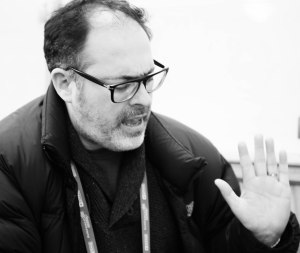
© 2013 Michael Coles
I’d spent a year getting visas to fly with the Pakistan military to 7,500 meters and basically the odds of that trip being successful was 1 in 3 so it would be pretty hypocritical of me to turn around to the climbers and say, “You know, you’re an idiot! Why are you taking such a risk?”
I had to tell my wife those statistics, actually, I don’t know if I gave her a full example, but I did have to meet her one Friday and say, “Look, here’s a card for a solicitor. You need to go and sign a will. What we’re doing is dangerous.” Primarily because everyone was telling us that going through the northern territories of Pakistan was a huge terrorism risk. In the end, it was absolutely fine.
In your opinion, what kind of person takes on the risks of a mountain like K2? When we started, I wanted to know what kind of person does this and why. As it turns out there are many reasons why they do what they do. K2 is surrounded by obsession. Wilco, the Dutch climber…this was his third attempt. Ger, this was his second. He was nearly killed in 2006. It just takes a certain kind of intense personality.
Ger McDonnell is a huge part of this film. What did you learn about him through this process? Ger wasn’t a commercial climber. He climbed for the spirituality and the love of climbing. He didn’t do it for sponsorship. He was embarrassed to tell people that he’d even climbed Everest. He wasn’t the kind of guy to go out and shout around what he’d accomplished. That’s why Ger was so central to the story. He was a little different from most of the other climbers. Some people climb for a living. You’ll see them in this film. You know, like the Sherpas and the western climbers. Some climb for a living and then go around giving motivational speeches and telling everyone about it. They are the professional adventurers. Ger was different. He wasn’t like that.
If you could give me a few words to sum up the essence of Ger, what would they be? He was a great guy, full of life. He was a real gentle man…a diplomat on the mountain. He was well liked and kind and accepting. I’d also add that I don’t believe he was hardwired to be a K2 climber. The unwritten code of the mountain is that if a climber gets in trouble or goes off course, he’s on his own. Ger just couldn’t leave those guys on the mountain to die without trying to help them first.

© 2013 Michael Coles
What has been the high point of the Sundance Film Festival for you? The Festival has been absolutely incredible and I’m so proud to have been able to show The Summit here. Also, the audiences are astounding. We have been playing to packed audiences and people have been getting turned away at every screening.
How have you enjoyed Park City? Absolutely. It’s a great place. Very beautiful.
Nick Ryan, thank you very much. It’s been lovely to meet you and learn more about the process of making The Summit. You’re welcome.
Read Full Post »
 In our home, we typically eat fish once a week throughout the year. During Lent we eat it on Fridays. I tend to serve salmon because it’s a healthy protein, high in vitamin A and omega-3 fatty acids, which are essential for proper brain and heart function. My favourite places to buy salmon in Ireland are Caviston’s Food Emporium in Glasthule, Donnybrook Fair, and Marks & Spencer.





 In an Irish Home