Feeds:
Posts
Comments

Archive for April, 2013

Darina Allen by Koster Photography.jpgI don’t know how I missed it!

Every now and again for the past year, I’ve been googling “Darina Allen” looking for a blog. Surely Ireland’s most celebrated cookery writer and founder of the Ballymaloe Cookery School would have one. Then, last month, I noticed a comment about Darina Allen and her relatively new blog whilst looking at the Irish Food Bloggers Association website.

It seems Darina started blogging on 14th June last year. In her own words, “it was a rough start initially” but in the last eight months she’s really taken off…literally. Darina’s blog reads more like a journal of food travels than recipes. To date she’s taken us to such places as Cambodia, New York, Sri Lanka, Mexico and, of course, all around Ireland in search of discovering food trends.

For those who don’t know her, Darina is to Ireland what Alice Waters is to America. She is credited with starting up the first Irish farmers market a decade ago. There are now over 150 of them across Ireland. Three years ago, she and Waters put forward an idea that lead to the Slow Movement’s Annual Grandmother’s Day, with the hope that grandmother’s Forgotten Skillscould help end child obesity by teaching their grandchildren to plant and cook dishes made with fresh local ingredients. She is author of 16 books, including Forgotten Skills of Ireland, Ballymaloe Cookery Course and, an old standby, Simply Delicious.

I had the good fortune of meeting Darina while attending the Ballymaloe Cookery School in Shangarry, County Cork many years ago. She’s a quick wit, a wonderful teacher, and a food activist in Ireland and beyond. Ballymaloe is one of the only cooking schools in the world located on an entirely organic farm. In fact, it was my time spent at Ballymaloe which led to me developing organic kitchen gardens at our home in Ireland and in America.

If you visit Ireland and have an interest in cooking, consider a trip to Ballymaloe…there is a 12 week certificate course, over 60 shorter courses, and many afternoon classes to enjoy. And, if you’re just a fan and want to know what Darina’s getting up to, check out her blog.

And, if by chance you’re visiting the Cork area this weekend, Darina is hosting the first ever Ballymaloe Literary Festival of Food and Wine at the Grain Store, Ballymaloe House and Ballymaloe Cookery School.

BallymaloeLitFestFoodWine250[1]There will be an incredible line-up of over 40 speakers including: Alice Waters, Madhur Jaffery, Claudia Roden, Bill Yosses (The American White House Pastry Chef) Stephanie Alexander (from Australia), Claus Meyer, Camilla Plus, Rowley Leigh, and David Thompson. Jancis Robinson MW and her husband Nick Lander are coming over from the U.K., as are Joanna Blythman, and some of the new young voices in food: Thomasina Miers, Stevie Parle, Alys Flowler, and Claire Ptak. And, that’s just the beginning. This international cast will be matched by a strong Irish presence. You’ll have to look at the Litfest.ie website to get the whole picture. It’s quite a tempting line-up!

Happy reading and cooking.

Read Full Post »

DSC_0486Isn’t it always the case that when you talk about something not happening it frequently ends up happening?

I should have known better than to end my post on porridge with, “I wish you and your family all the good health that my little family has enjoyed these past few months.” That one line was just too tempting for the powers that be. Less than 24 hours after hitting the “Publish” button, one of the children came home with a cough…which turned into a fever… and then a sore throat…that was diagnosed as a virus… and the next four days were misery for the poor dear.

Immediately, I shifted into nurse-mom mode and initiated a host of health promoting cures: salt-water gargle, humidifier in the bedroom, increase of fluids (including warm lemon water with ginger and honey to soothe a sore throat), nasal irrigation (our G.P. thinks using a Neti-Pot is a great way to keep the nose clear and help reduce post-nasal drip which may cause a sore throat or a cough), and, my very favourite, homemade chicken soup.

Chicken soup?! What a load of hooey…or is it? The benefits of chicken soup were first reported centuries ago, but there’s never been any real proof about its efficacy, until now. University of Nebraska Medical Center physician and researcher Stephen Rennard, put the chicken soup folk remedy to the test by taking it out of the kitchen and into his laboratory. What he discovered has settled the dispute, once and for all.

In his findings, Dr. Rennard proved chicken soup has a number of substances, including an anti-inflammatory mechanism, that helps ease the symptoms of upper respiratory tract infections.

Though he was not able to identify the exact ingredient or ingredients in the soup that make it effective against fighting colds, Dr. Rennard theorizes it may be a combination of ingredients in the soup that work together to have beneficial effects.

And there you have it…no longer just a wives tale…good old fashioned chicken soup…mother approved and doctor tested. Be well!

Good Old Fashioned Chicken Soup with Orzo

Serves  6 to 8

Ingredients

1 tablespoon vegetable oil

1 whole chicken, skin left on, cut into pieces including breasts, split in two, wings, drumsticks, thighs, and back

1 large onion, cut into medium dice

4 pints/2 quarts boiling water

2 teaspoons table salt

2 bay leaves

2 cloves garlic, thinly sliced

1 1/4”/3cm ginger, sliced

2 large carrots, peeled and sliced

2 medium ribs celery, sliced

1 cup/2oz shredded green cabbage

¼ teaspoon dried thyme

½ cup/100gm orzo (may substitute noodles)

fresh parsley leaves, chopped for garnish

Ground black pepper

Directions

1. Heat oil in large soup pot. When oil shimmers and starts to smoke, add chicken and sauté until brown on all sides.

2. Remove chicken and set aside. Add half of chopped onions to pot and sauté until colored and softened slightly, about 3 to 5 minutes.

3. Add chicken pieces, except for the breasts, back to pot, reduce heat to low, cover, and simmer until chicken is fully cooked and releases its juices, about 20 minutes.

4. Increase heat to high, add boiling water along with the two breast halves, salt, ginger, garlic, and bay leaves and bring to a rapid boil. Reduce heat and simmer, covered, until chicken breasts are cooked and broth is rich and flavorful, about 20 minutes.

5. Remove chicken breasts from pot and set aside. Strain broth, discarding bones, and set aside.

6. Skim fat from broth, reserving two tablespoons which should be added back to soup pot. Return soup pot to medium-high heat. Add remaining onions, along with carrot, cabbage, and celery and sauté until softened, about 5 minutes.

7. Remove skin from cooled chicken and shred the meat into bite sized pieces. Discard skin and bones.

8. Add thyme, strained broth, chicken, and orzo to the soup pot. Simmer until vegetables are tender, about 10 to 15 minutes.

9. Taste, adjust seasoning, serve with chopped parsley, if desired.

Read Full Post »

DSC_0469 (2)For the past few months I’ve had the family on a bit of a health kick. The plan has been to focus on the usual triad: getting more sleep, taking regular exercise, and carving out time for leisure activities like reading, puzzles, board games, movies, and cooking together. Surprisingly, these simple changes have been difficult to incorporate into our lives but, ever so slowly, we are making progress. Another area I decided to focus on was the family breakfast.

Like most Irish people, we typically start our day with cereal, fruit, yogurt, or a boiled egg and toast. This past autumn, I broadened the options to include homemade muesli, a variety of smoothies, and {my favourite} steel cut oatmeal, known in Ireland as porridge.

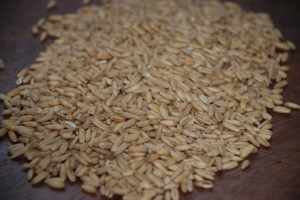
Rolled Oats on the left and Steel Cut Oats on the right.

Rolled Oats on the left and Steel Cut Oats on the right.

Until recently I never gave much thought to porridge. I knew it came as rolled, quick-cook and steel-cut/pinhead oats and that the latter is said to be the healthiest option because it is higher in fiber, both insoluble and soluble. I also knew, and I’m not meaning to go too deep here, that scientific research suggests soluble fiber, in particular, lowers cholesterol and may help lower the risk of heart disease for men and women alike. Otherwise, all I’ve known about porridge was that my late father-in-law ate it nearly every morning of his post-career life, giving it near “legendary” status in the McGuire clan…but that’s a story for another day’s telling.

I have since learned porridge is an ancient food made from oat groats. It has been grown in Ireland for thousands of years because the oat, a rain tolerant grain, grows well in our climate. It has been known as Stirabout but I’ve never heard my friends, or even my lovely mother-in-law, call it that nor have I seen it mentioned in modern cookbooks as such. Long ago, if made with water in an almost soup-like consistency, it was known as Skilly or Gruel, and would have been eaten at supper. And, one thing that seems to have remained fairly consistent throughout time is how porridge has, for the most part, been prepared: boiled with water or milk and served with a bit of cream, sugar, honey, seeds, or fruit on top.

There are oat mills still in existence in Ireland and many oatmeal brands. Perhaps the most internationally recognised one is McCann’s Steel Cut Oatmeal, but it is no longer Irish owned. My favourite is Flahavan’s Pinhead, which has been milled by the Flahavan family in Kilmacthomas, Co. Flahavan's OatmealWaterford for more than 200 years. Macroom Oatmeal is another brand. It is less well-known but has, most notably, been served at Ballymaloe House for many years and is for sale at the Ballymaloe Cookery School and on their website. It is has an almost cult-like following so, as soon as possible, I will try it and give you the scoop.

Until then, I wish you and your family all the good health that my little family has enjoyed these past few months. Let me know what you are doing to keep healthy this year. Be well!

Traditional Irish Porridge

Serves 4

Ingredients

1 cup/7oz steel cut (or pinhead) oats

4 cups/2 pints water, milk or half of each, whichever you prefer

Directions

1. The night before, bring the water to a rapid boil.

2. Slowly add the oatmeal, mixing all the time, and bring the water back to the boil.

3. Turn off heat, cover and leave to set overnight.

4. Next morning, add more water (or milk), stir and reheat.

5. Top with toasted nuts, cinnamon, brown sugar, golden syrup, honey, fruit, cream, milk or whatever you desire.

From Atlantic Monthly Magazine: http://www.theatlantic.com/health/archive/2009/06/irelands-renowned-oatmeal/19125/

A bit of history about Irish porridge at http://culinarytravels.co.uk/2010/10/22/porridge/

Some history about Flahavan’s Oat Mill at http://culinarytravels.co.uk/2010/10/22/porridge/

About Macroom Oatmeal Mill at http://www.ireland-guide.com/establishment/macroom-oatmeal-mills.10857.html

Read Full Post »