Feeds:
Posts
Comments

Posts Tagged ‘Ireland’

Rhubarb Margaritas (17)Today’s post is a collision of two good things: Cinco de Mayo and the plethora of rhubarb growing in our garden. Yep, that’s right, in this Irish home we made Rhubarb Margaritas tonight and they were amazing. Forget that rhubarb is choc full of Vitamin C, high in fibre, and a good source of calcium…forget it altogether. The only thing you need to know about Rhubarb Margaritas is they are soooo good.

If you are of legal drinking age and you like margaritas…this recipe is one you need to try. I’d even go so far as to say that even if you don’t like rhubarb, you should try this.

The internet has oodles of strawberry rhubarb margarita recipes but truly I’d keep it simple and give the strawberries a miss. We’ll find another use for them.

So, that’s it Dear Readers. Today’s post is short and sweet. ¡Olé!

Rhubarb Margaritas

Makes 4 Drinks

Ingredients

1 cup Rhubarb simple syrup

1/2 cup fresh lime juice (about 8 limes)

1/2 cup tequila

1/2 cup Grand Marnier

Ice, crushed or whole

Directions

1. In a pitcher mix the first four ingredients and stir well.

2. Run one of the squeezed limes around the rim of four glasses. Dip each rim in sugar.

3. Fill glasses with ice and the rhubarb mix. If you decide to make frozen rhubarb margaritas, blend one to two cups of ice with the rhubarb mix.

4. Garnish with a slice of lime.

Rhubarb Margaritas (8)Rhubarb Simple Syrup

Makes About 3 Cups/24oz

Ingredients

1 lb rhubarb, chopped in small pieces

2 cups/16oz sugar

2 cups/1 pint water

Directions

1. Add rhubarb, sugar and water in a non-reactive pan.

2. Heat on medium heat and simmer until rhubarb is soft.

3. Place sterilised cheesecloth over a strainer, propped over a bowl. Pour rhubarb into cheesecloth and let drip through for about an hour. Let cool and keep in the fridge until ready to use.

Read Full Post »

Darina Allen by Koster Photography.jpgI don’t know how I missed it!

Every now and again for the past year, I’ve been googling “Darina Allen” looking for a blog. Surely Ireland’s most celebrated cookery writer and founder of the Ballymaloe Cookery School would have one. Then, last month, I noticed a comment about Darina Allen and her relatively new blog whilst looking at the Irish Food Bloggers Association website.

It seems Darina started blogging on 14th June last year. In her own words, “it was a rough start initially” but in the last eight months she’s really taken off…literally. Darina’s blog reads more like a journal of food travels than recipes. To date she’s taken us to such places as Cambodia, New York, Sri Lanka, Mexico and, of course, all around Ireland in search of discovering food trends.

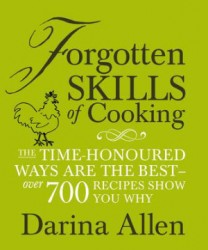
For those who don’t know her, Darina is to Ireland what Alice Waters is to America. She is credited with starting up the first Irish farmers market a decade ago. There are now over 150 of them across Ireland. Three years ago, she and Waters put forward an idea that lead to the Slow Movement’s Annual Grandmother’s Day, with the hope that grandmother’s Forgotten Skillscould help end child obesity by teaching their grandchildren to plant and cook dishes made with fresh local ingredients. She is author of 16 books, including Forgotten Skills of Ireland, Ballymaloe Cookery Course and, an old standby, Simply Delicious.

I had the good fortune of meeting Darina while attending the Ballymaloe Cookery School in Shangarry, County Cork many years ago. She’s a quick wit, a wonderful teacher, and a food activist in Ireland and beyond. Ballymaloe is one of the only cooking schools in the world located on an entirely organic farm. In fact, it was my time spent at Ballymaloe which led to me developing organic kitchen gardens at our home in Ireland and in America.

If you visit Ireland and have an interest in cooking, consider a trip to Ballymaloe…there is a 12 week certificate course, over 60 shorter courses, and many afternoon classes to enjoy. And, if you’re just a fan and want to know what Darina’s getting up to, check out her blog.

And, if by chance you’re visiting the Cork area this weekend, Darina is hosting the first ever Ballymaloe Literary Festival of Food and Wine at the Grain Store, Ballymaloe House and Ballymaloe Cookery School.

BallymaloeLitFestFoodWine250[1]There will be an incredible line-up of over 40 speakers including: Alice Waters, Madhur Jaffery, Claudia Roden, Bill Yosses (The American White House Pastry Chef) Stephanie Alexander (from Australia), Claus Meyer, Camilla Plus, Rowley Leigh, and David Thompson. Jancis Robinson MW and her husband Nick Lander are coming over from the U.K., as are Joanna Blythman, and some of the new young voices in food: Thomasina Miers, Stevie Parle, Alys Flowler, and Claire Ptak. And, that’s just the beginning. This international cast will be matched by a strong Irish presence. You’ll have to look at the Litfest.ie website to get the whole picture. It’s quite a tempting line-up!

Happy reading and cooking.

Read Full Post »

It’s Halloween and the veil between the living and the dead is slowly drawing back! Tonight all across the land, ghosts and ghouls will roam freely.

In Ireland we have our share of strange and evil figures and haunted places. From Seaforth House to Loftus Hall, Friars Bush to Charleville Castle the spirits of the “other world” are out in force to frighten us.

Leap Castle in County Offaly is owned by the Ryan family. Built on an ancient Druid site, it has a history of murder and death.

Take care as you venture out tonight…the ghosts of Ireland are watching you. Happy Halloween!

Related Articles

More haunted places in Ireland at: http://blog.discoverireland.com/2011/10/irelands-most-haunted-places/

Ghost stories from Ireland at http://blog.discoverireland.com/2012/10/ghost-stories-ireland/

Read Full Post »

Photo Credit: Tracy Rhodes on Flickr

With March 17th fast approaching it’s hard to know what’s Irish and what’s not…unless, of course, you’re living in Ireland. Green beer, four-leafed shamrocks, corned beef and cabbage, wearing green…these are often touted as being Irish but they’re not. They’re Oirish (pronounced oye-rish). Oirish has nothing to do with Ireland except that it’s a term, coined by not-so-amused Irish people, to describe anything associated with tourists or the tourist trade in Ireland that paints the country as the land of blarney stones and leprechauns. It probably started back in the 70’s when well-intentioned visitors would arrive to the Emerald Isle by the (airplane) load wearing Kelly green trousers and greeting locals with “Top of the morning to ya”.

In all my years of living in Ireland, I’ve never heard an Irish person use that phrase to greet someone. They may say, “Are you well?“, “How’s Kim? ” or even just a simple “Good morning.”, but that’s about it. Strange how the image of the Irish culture outside of Ireland has gone so awry when, quite literally, millions of Irish people have left the country and populated other countries for more than 100 years.

St. Patrick’s Day Ireland 2010

For the record, Saint Patrick’s Day, also known as Paddy’s Day (and not Patty’s Day), is a religious holiday celebrating the life and teachings of St. Patrick. Most people will go to Mass in the morning, attend a parade in their local village in the afternoon, and have their tea (supper) in the evening. They will not be eating corned beef and cabbage. More likely they will eat bacon (Irish ham) with cabbage and potatoes or roast pork or lamb with mashed potatoes and a veg (vegetable). My good friend Linda will be serving her family roast lamb, smothered in garlic and olive oil, with roasted veg and mashed potatoes. In our home it would be (and will be) ham.Truth is, there really isn’t a “traditional” meal for St. Patrick’s Day that gets served by every home throughout the country.

As for the other two popular Oirish traditions, here are the facts:

Drink: No self-respecting Irish person drinks green alcoholic beverages on Paddy’s Day. Instead, if they do head to the pubs, they will be drinking Guinness, Murphy’s, Harp, Smithwicks, Carlsburg, Budweiser (yes, Budweiser), Bulmers (an alcoholic beverage made from apples), Jameson and Bushmills (whiskeys). The men will typically drink “pints” and the ladies will have a “glass”. If you’re out with friends, you’ll buy in “rounds” (the practice of taking turns buying a drink for everyone in your group) or else you’ll be seen to be “mean” (cheap).

Shamrocks: A shamrock is not the same thing as a four-leaf clover. If it has four leaves, it is not a shamrock. The shamrock became synonymous with Ireland due to the teachings of St. Patrick. Legend has it that Patrick used the humble shamrock, which grows wild in Ireland and only has three leaves, to describe the Catholic teaching of the Holy Trinity (Father, Son and Holy Spirit). Today, Shamrocks are blessed and given out after Mass on St. Patrick’s Day and they are often worn on a shirt or jacket lapel for the day. Irish people do not typically wear any other “special” green attire on the day and they do not practice the tradition of pinching someone for not wearing green.

If you’re seriously interested in having an authentically Irish St. Patrick’s Day (and you happen to live in America) here are my suggestions:

1. In the morning go to Mass.

2. When you get home, serve a real Irish fry-up for breakfast. That would be eggs, rashers, sausages, black and white pudding, grilled tomato, soda bread with jam and butter and tea (Barry’s Gold Blend is our favourite).

3. Find a local parade to attend.

4. When you get back home, serve a traditional Irish supper (recipe below is from my mother-in-law), toast your true Irish roots and, for dessert, serve a lovely warm rhubarb pie with a dollop of hand-whipped cream.

Slan!

Irish Bacon & Cabbage with Boiled Potatoes

Serves 6

4-5lb/2-2.5kg shoulder or loin of bacon, with a thin rind of fat still on the meat (this MUST be Irish bacon…see below)

4 tablespoons honey

10 cloves

1 head of cabbage, outer leaves trimmed, cut into quarters

1-1/2 pounds New Potatoes, scrubbed clean

Directions

1. Cover the bacon with water.

2. Add the honey and cloves and slowly bring to the boil.

3. If the bacon is salty, a white froth will form on the water. If this happens, change the water and start again. Keep doing this until the froth no longer appears. Allow the water to come to the boil and then simmer gently for 20 minutes to the pound or 45 minutes to the kilogram.

4. About 30 minutes before the bacon is fully cooked, add the quartered cabbage and allow to cook until the cabbage is tender and the bacon is fully cooked.

5. Remove the bacon to a cutting board and cover with aluminium. Remove the cabbage to a serving dish, add a generous dollop of butter and some salt and pepper to taste, and put in a warming drawer until ready to serve. Remove the cloves from the pot.

6. Add waxy New Potatoes or small potatoes to the pot of bacon water, making sure to remove or add water such that the potatoes are nearly but not completely covered, and bring to the boil. Once the water boils, turn the heat down, cover with a lid, and simmer for 30 minutes or until the potatoes are fork-tender. Drain and season with salt, pepper and butter to taste.

7. To serve, slice the bacon and bring to the table with the cabbage and boiled potatoes.

Notes:

This recipe only works with Irish bacon…please don’t try this recipe with something that’s not been cured in Ireland. If you live outside the country, try to buy the bacon from an Irish shop in your area or buy it online from an Irish supplier. In North America, I have bought this cut of pork from a website called FoodIreland.com.

Read Full Post »

As St. Patrick’s Day draws near, I’m missing the life my lovely family and I left in Ireland one-and-a-half years ago. Our home in the country is situated between the mountains and the sea. Our daily village traffic jam is only ever caused by farm animals, elegant equestrians or the 184 bus getting stuck around a tight bend. From the upstairs windows of our home we can see a row of trees on a distant hill, which remind me of Africa (imagine elephants walking tail to trunk), and a gorgeous blue line that is the Irish Sea. On occasion, a rainbow will appear in our back garden – a gift like none other.

On warm days, the laundry hangs on a rotating clothes line in the side garden and reminds me of my mother-in-law…how many clothes she must have hung on her own line over the years as she raised her twelve children. Not just for a place for drying clothes, our garden is also a sanctuary, a place where we go to get away from the hubbub of the city, and a place for raising fruits, vegetables, flowers and happy children. In this tranquil space, our girls have the freedom to run like fairies across the expansive green lawn and exhaust  themselves in childhood games of hide and seek or jump high enough on the trampoline to dream of touching the sky.

Our life in Ireland is a busy but respectable one. We don’t find ourselves running crazily from one event or task to the other. Life is just a bit slower in Ireland than America. We have time to call in (stop by) to a friend’s home for a cuppa (cup of tea and a chat) or take a stroll along the pier. I make soda bread or brown bread every week. Dinners are not a rushed stop at the Whole Foods grocery store but whole foods made at home, at my hob (stove) with the younger daughter usually by my side. For tea (dinner time) we sit around the table together and talk about school and work and we give thanks for what we share.

Wednesday nights are always very special: my husband’s extended family join us and the house grows full with granny, aunties, uncles and cousins under one roof. We call this tradition, Family Dinner Night, and it was started when our older daughter was just a baby. The dream was to have her grow up surrounded by laughter, stories and memories that belonged solely to our family. It’s amazing to have three generations sit together every week…year in…year out.

Yes, today I miss our lovely life in Ireland. As Saint Patrick’s Day gets ever more close, I am reflective and thankful for the life we have lived between the Irish Sea and the mountains. I look forward to getting back there in a few months time: to seeing family, friends, the horses, my garden and the trees on the distant hill. Thank you, Dear Readers, for letting me process my melancholy.  Now, anyone for a slice of meringue roulade and a cuppa?

Mixed Fruit Meringue Roulade

Serves 6

4 large egg whites

225g/8oz/1-1/4 cup sugar (caster)

500ml/1 pint/2 cups cream, whipped

450g/1lb mixed fruit, quartered, plus two strawberries halved (for mixed fruit I use bananas, strawberries, pineapple, apples, raspberries, blackberries, kiwi as available and in season)

Extra whipped cream for decorating

Directions

1. Position rack in center of oven and preheat to 150°C/300°F. Line a 30 x 20cm/12 x 8 inch swiss roll tin/baking sheet with parchment paper, extending a little over ends of pan.

2. Beat the egg whites and half the sugar using an electric whisk until soft peaks form. Gradually add the remaining sugar, continuing to whisk until the meringue forms stiff peaks. To test: lift the beater out of the meringue and turn upside down. If the meringue peak holds its shape you are done.

3. Spread the meringue evenly on to baking sheet/swiss roll tin and bake for one hour.

4. Remove from oven and cool to touch. Turn meringue out on to a clean tea towel. Carefully peel off the parchment paper and allow to cool fully. The meringue may be crumbly.

5. Spread an even layer of whipped cream over the meringue, leaving a 2 inch border on three sides. Sprinkle the mixed fruit over the cream.

6. Starting at one long side, gently roll up the meringue, enclosing the filling. Place roulade, seam side down on a plate or platter. Garnish with dollops of cream and a strawberry. Note: will keep in the refrigerator for 1-3 hours.

Read Full Post »

Hey all you Irish single ladies…if the man of your dreams hasn’t “put a ring on it” yet, then you’re in luck. According to Irish tradition, February 29th (which only falls every four years in what’s known as a “Leap Year”), is the one day when it’s perfectly acceptable for you to propose to the man of your liking.  It seems we have good ol’ Saint Brigid, the female patron saint of Ireland, to thank for this welcomed tradition.

According to legend, Saint Brigid was giving out (complaining) to Saint Patrick way back in the fifth century about how unfair it was for women to have to wait for men to ask for their hand in marriage. Saint Patrick, being the kind man that he was, took pity on the ladies of the day and deemed it acceptable for the women of Ireland to propose in a leap year.

Back to modern-day, actress Amy Adams brought this little known tradition to light in the film Leap Year in 2010 (which incidentally wasn’t a “leap year”). In the film, Anna Brady (played by Adams) travels to Dublin, Ireland to propose to her boyfriend Jeremy on February 29 because, according to Irish tradition, a man who receives a marriage proposal on a leap day must accept it. As it turns out, Anna falls in love with someone else (an Irish man of course) and the two end up living happily ever after on the Dingle Peninsula in Co. Kerry. Such is the stuff of romantic comedies!

If you’ve been waiting for your “happily ever after”, wait no more because today is the day. Take matters into your own hands and pop the question. And, assuming the answer is a resounding “yes”, pop a bottle of bubbly and toast your future happiness with an Irish Black Velvet.

Black Velvets

4 ozs chilled Champagne

4 ozs chilled Guinness Stout

Directions

1. Pour the Guinness Stout into a fluted glass and top it with the Champagne. Serve immediately.

Read Full Post »

Bread baking has long been part of Ireland’s culinary heritage.  The earliest breads were little more than thin oatcakes baked over the fire on an iron plate or placed directly on embers. In the mid-1800’s bicarbonate of soda (baking soda) was introduced and the birth of soda bread, as it is known in Ireland today, was born.

My first introduction to Brown Soda Bread was at the kitchen table of my mother-in-law.  Every week she made a loaf from scratch.  She worked quickly and efficiently, as only a woman who raised twelve children can do, and when the bread came out of the oven the smell was just delicious!

Both nourishing and comforting, Irish Soda Bread is perfect in the morning for breakfast, as part of a sandwich at lunchtime or served with a hearty homemade soup or a green salad fresh from the garden in the evening.

Brown Soda Bread

Makes One Loaf

225g self raising flour

225g extra coarse wholemeal

1 teaspoon bicarbonate of soda

1 teaspoon salt

about 450ml buttermilk

Directions

1.  Preheat the oven to 180C. Put a little vegetable oil into a bread tin and put the tin into the oven to warm.  When the oil is warm, use a pastry brush to get it all over the inside of the tin.  Set aside.

2.  Sieve the two flours, the soda and salt in a large bowl.

3.  Make a well in the centre and pour in most of the buttermilk.

4.  Using a wooden spoon or your hand, stir the liquid into the flour.  The dough should be soft but not sticky.  If needed, add more buttermilk to get the right consistency.

5.  Put the mixture into the bread tin and bake for one hour in the center of the oven.  Ease the loaf from the tin and tap the bottom.  If it sounds hollow when tapped it is cooked.  If not, put it back into the oven for another 5-10 minutes.  There’s no need to put the loaf into the bread tin for this, just place it right on the rack in the oven.

6.  When baked completely, cool on a wire rack.

Read Full Post »

« Newer Posts