Feeds:
Posts
Comments

Darina Allen by Koster Photography.jpgI don’t know how I missed it!

Every now and again for the past year, I’ve been googling “Darina Allen” looking for a blog. Surely Ireland’s most celebrated cookery writer and founder of the Ballymaloe Cookery School would have one. Then, last month, I noticed a comment about Darina Allen and her relatively new blog whilst looking at the Irish Food Bloggers Association website.

It seems Darina started blogging on 14th June last year. In her own words, “it was a rough start initially” but in the last eight months she’s really taken off…literally. Darina’s blog reads more like a journal of food travels than recipes. To date she’s taken us to such places as Cambodia, New York, Sri Lanka, Mexico and, of course, all around Ireland in search of discovering food trends.

For those who don’t know her, Darina is to Ireland what Alice Waters is to America. She is credited with starting up the first Irish farmers market a decade ago. There are now over 150 of them across Ireland. Three years ago, she and Waters put forward an idea that lead to the Slow Movement’s Annual Grandmother’s Day, with the hope that grandmother’s Forgotten Skillscould help end child obesity by teaching their grandchildren to plant and cook dishes made with fresh local ingredients. She is author of 16 books, including Forgotten Skills of Ireland, Ballymaloe Cookery Course and, an old standby, Simply Delicious.
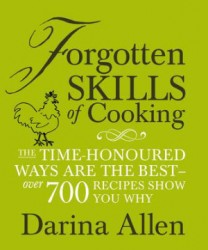
I had the good fortune of meeting Darina while attending the Ballymaloe Cookery School in Shangarry, County Cork many years ago. She’s a quick wit, a wonderful teacher, and a food activist in Ireland and beyond. Ballymaloe is one of the only cooking schools in the world located on an entirely organic farm. In fact, it was my time spent at Ballymaloe which led to me developing organic kitchen gardens at our home in Ireland and in America.

If you visit Ireland and have an interest in cooking, consider a trip to Ballymaloe…there is a 12 week certificate course, over 60 shorter courses, and many afternoon classes to enjoy. And, if you’re just a fan and want to know what Darina’s getting up to, check out her blog.

And, if by chance you’re visiting the Cork area this weekend, Darina is hosting the first ever Ballymaloe Literary Festival of Food and Wine at the Grain Store, Ballymaloe House and Ballymaloe Cookery School.

BallymaloeLitFestFoodWine250[1]There will be an incredible line-up of over 40 speakers including: Alice Waters, Madhur Jaffery, Claudia Roden, Bill Yosses (The American White House Pastry Chef) Stephanie Alexander (from Australia), Claus Meyer, Camilla Plus, Rowley Leigh, and David Thompson. Jancis Robinson MW and her husband Nick Lander are coming over from the U.K., as are Joanna Blythman, and some of the new young voices in food: Thomasina Miers, Stevie Parle, Alys Flowler, and Claire Ptak. And, that’s just the beginning. This international cast will be matched by a strong Irish presence. You’ll have to look at the Litfest.ie website to get the whole picture. It’s quite a tempting line-up!

Happy reading and cooking.

DSC_0486Isn’t it always the case that when you talk about something not happening it frequently ends up happening?

I should have known better than to end my post on porridge with, “I wish you and your family all the good health that my little family has enjoyed these past few months.” That one line was just too tempting for the powers that be. Less than 24 hours after hitting the “Publish” button, one of the children came home with a cough…which turned into a fever… and then a sore throat…that was diagnosed as a virus… and the next four days were misery for the poor dear.

Immediately, I shifted into nurse-mom mode and initiated a host of health promoting cures: salt-water gargle, humidifier in the bedroom, increase of fluids (including warm lemon water with ginger and honey to soothe a sore throat), nasal irrigation (our G.P. thinks using a Neti-Pot is a great way to keep the nose clear and help reduce post-nasal drip which may cause a sore throat or a cough), and, my very favourite, homemade chicken soup.

Chicken soup?! What a load of hooey…or is it? The benefits of chicken soup were first reported centuries ago, but there’s never been any real proof about its efficacy, until now. University of Nebraska Medical Center physician and researcher Stephen Rennard, put the chicken soup folk remedy to the test by taking it out of the kitchen and into his laboratory. What he discovered has settled the dispute, once and for all.

In his findings, Dr. Rennard proved chicken soup has a number of substances, including an anti-inflammatory mechanism, that helps ease the symptoms of upper respiratory tract infections.

Though he was not able to identify the exact ingredient or ingredients in the soup that make it effective against fighting colds, Dr. Rennard theorizes it may be a combination of ingredients in the soup that work together to have beneficial effects.

And there you have it…no longer just a wives tale…good old fashioned chicken soup…mother approved and doctor tested. Be well!

Good Old Fashioned Chicken Soup with Orzo

Serves  6 to 8

Ingredients

1 tablespoon vegetable oil

1 whole chicken, skin left on, cut into pieces including breasts, split in two, wings, drumsticks, thighs, and back

1 large onion, cut into medium dice

4 pints/2 quarts boiling water

2 teaspoons table salt

2 bay leaves

2 cloves garlic, thinly sliced

1 1/4”/3cm ginger, sliced

2 large carrots, peeled and sliced

2 medium ribs celery, sliced

1 cup/2oz shredded green cabbage

¼ teaspoon dried thyme

½ cup/100gm orzo (may substitute noodles)

fresh parsley leaves, chopped for garnish

Ground black pepper

Directions

1. Heat oil in large soup pot. When oil shimmers and starts to smoke, add chicken and sauté until brown on all sides.

2. Remove chicken and set aside. Add half of chopped onions to pot and sauté until colored and softened slightly, about 3 to 5 minutes.

3. Add chicken pieces, except for the breasts, back to pot, reduce heat to low, cover, and simmer until chicken is fully cooked and releases its juices, about 20 minutes.

4. Increase heat to high, add boiling water along with the two breast halves, salt, ginger, garlic, and bay leaves and bring to a rapid boil. Reduce heat and simmer, covered, until chicken breasts are cooked and broth is rich and flavorful, about 20 minutes.

5. Remove chicken breasts from pot and set aside. Strain broth, discarding bones, and set aside.

6. Skim fat from broth, reserving two tablespoons which should be added back to soup pot. Return soup pot to medium-high heat. Add remaining onions, along with carrot, cabbage, and celery and sauté until softened, about 5 minutes.

7. Remove skin from cooled chicken and shred the meat into bite sized pieces. Discard skin and bones.

8. Add thyme, strained broth, chicken, and orzo to the soup pot. Simmer until vegetables are tender, about 10 to 15 minutes.

9. Taste, adjust seasoning, serve with chopped parsley, if desired.

DSC_0469 (2)For the past few months I’ve had the family on a bit of a health kick. The plan has been to focus on the usual triad: getting more sleep, taking regular exercise, and carving out time for leisure activities like reading, puzzles, board games, movies, and cooking together. Surprisingly, these simple changes have been difficult to incorporate into our lives but, ever so slowly, we are making progress. Another area I decided to focus on was the family breakfast.

Like most Irish people, we typically start our day with cereal, fruit, yogurt, or a boiled egg and toast. This past autumn, I broadened the options to include homemade muesli, a variety of smoothies, and {my favourite} steel cut oatmeal, known in Ireland as porridge.

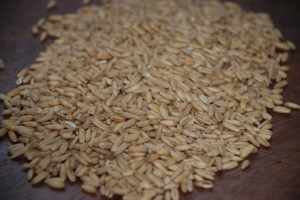
Rolled Oats on the left and Steel Cut Oats on the right.

Rolled Oats on the left and Steel Cut Oats on the right.

Until recently I never gave much thought to porridge. I knew it came as rolled, quick-cook and steel-cut/pinhead oats and that the latter is said to be the healthiest option because it is higher in fiber, both insoluble and soluble. I also knew, and I’m not meaning to go too deep here, that scientific research suggests soluble fiber, in particular, lowers cholesterol and may help lower the risk of heart disease for men and women alike. Otherwise, all I’ve known about porridge was that my late father-in-law ate it nearly every morning of his post-career life, giving it near “legendary” status in the McGuire clan…but that’s a story for another day’s telling.

I have since learned porridge is an ancient food made from oat groats. It has been grown in Ireland for thousands of years because the oat, a rain tolerant grain, grows well in our climate. It has been known as Stirabout but I’ve never heard my friends, or even my lovely mother-in-law, call it that nor have I seen it mentioned in modern cookbooks as such. Long ago, if made with water in an almost soup-like consistency, it was known as Skilly or Gruel, and would have been eaten at supper. And, one thing that seems to have remained fairly consistent throughout time is how porridge has, for the most part, been prepared: boiled with water or milk and served with a bit of cream, sugar, honey, seeds, or fruit on top.

There are oat mills still in existence in Ireland and many oatmeal brands. Perhaps the most internationally recognised one is McCann’s Steel Cut Oatmeal, but it is no longer Irish owned. My favourite is Flahavan’s Pinhead, which has been milled by the Flahavan family in Kilmacthomas, Co. Flahavan's OatmealWaterford for more than 200 years. Macroom Oatmeal is another brand. It is less well-known but has, most notably, been served at Ballymaloe House for many years and is for sale at the Ballymaloe Cookery School and on their website. It is has an almost cult-like following so, as soon as possible, I will try it and give you the scoop.

Until then, I wish you and your family all the good health that my little family has enjoyed these past few months. Let me know what you are doing to keep healthy this year. Be well!

Traditional Irish Porridge

Serves 4

Ingredients

1 cup/7oz steel cut (or pinhead) oats

4 cups/2 pints water, milk or half of each, whichever you prefer

Directions

1. The night before, bring the water to a rapid boil.

2. Slowly add the oatmeal, mixing all the time, and bring the water back to the boil.

3. Turn off heat, cover and leave to set overnight.

4. Next morning, add more water (or milk), stir and reheat.

5. Top with toasted nuts, cinnamon, brown sugar, golden syrup, honey, fruit, cream, milk or whatever you desire.

From Atlantic Monthly Magazine: http://www.theatlantic.com/health/archive/2009/06/irelands-renowned-oatmeal/19125/

A bit of history about Irish porridge at http://culinarytravels.co.uk/2010/10/22/porridge/

Some history about Flahavan’s Oat Mill at http://culinarytravels.co.uk/2010/10/22/porridge/

About Macroom Oatmeal Mill at http://www.ireland-guide.com/establishment/macroom-oatmeal-mills.10857.html

Irish Coffee

Irish Coffee

Saint Patrick’s Day 2013 came and went a few days ago and nearly 400 of you stopped by In an Irish Home to see what really goes on behind the hall door of a typical Irish family. First and foremost, let me say “go raibh maith agat” (sounds like GUR-uh muh HAG-ut and means thank you). I am overwhelmed by your support and greatly appreciate your comments, visits, and decision to “follow” the musings of our family.

Hoping not to disappoint you, we were not in Ireland for Saint Patrick’s Day so I can’t tell you about the fantastic parade in Dublin city centre or the local events that took place around the country. Instead of being home, we decided to do as so many Irish government officials do every year…we headed to one of America’s capital cities…the capital city in fact…Washington, D.C.

Amongst the early blossoming Cherry trees and perfect weather, we visited The White House (albeit just the gates, garden and visitor centre thanks to the sequester), Capitol Hill, all the important historical monuments, the Smithsonian’s Air and Space Museum, National History Museum and American History Museum, George Washington’s Mount Vernon, and Georgetown. It was a whirlwind week!

In seven days we managed it all with near military precision. Two days were spent flying to and from D.C. and five days were spent taking in the sights {an itinerary will follow in an upcoming blog post in case you ever decide to visit Washington with your family}. When we finally made it back home we DSC00148were all more familiar with American history. We even discovered a few facts about Ireland’s influence on America’s most iconic city. For example, did you know that Irish-born-and-trained-architect James Hoban designed the White House? He did. It seems he won a competition for the job in 1792 and his inspiration for America’s First House is none other than our very own Leinster House in Dublin.

But I digress, the trip was wonderful and it left us completely shattered (exhausted). Come Paddy’s Day all I could think about was making an Irish coffee…with alcohol. I know we {my lovely husband and I} gave up drink for Lent but in Ireland, oddly enough, one gets a reprieve from their Lenten promises on the feast day of Saint Patrick!

So delicious!

So delicious!

Which takes me to the point of today’s recipe post…Irish Coffee. A perennial favourite of the Irish and visitors to Ireland alike, Irish coffee was first created by Joe Sheridan, a chef in the Port of Foyne {airport} in County Limerick, back in the mid-1940s. Legend has it a plane was turned back to Ireland while on its way to America due to bad weather conditions and the weary passengers took refuge in the airport terminal until they could once again depart. Sensing their exhaustion, Mr. Sheridan served hot coffee but made it a wee bit stronger than usual by adding whiskey. When a customer asked if it was a “Brazilian Coffee”, Joe replied “It’s an Irish Coffee”. And the rest, as they say, is history.

Enjoy!

Irish Coffee

For One Cup

Ingredients

1/2 cup/4 fl. oz. strong, hot coffee

1-2 tablespoons brown sugar (Demerara, Muscovado or Turbinado) or to taste

1/4 cup/2 fl. oz. Irish whisky or to taste

4 tablespoons lightly whipped fresh cream

Directions

1. Beat the whipping cream until stiff but not too firm.

2. Pre-heat a glass with freshly boiled water. Leave a metal spoon in the glass so the sudden change in temperature does not cause it to break.

3. After a minute or so, remove spoon, pour out hot water, and fill glass with hot coffee.

4. Add Tubinado sugar to the coffee and stir until completely dissolved.

5. Add Irish whiskey to the sweetened coffee and stir.

6. When the coffee has settled, top with a collar of whipped cream by carefully pouring the cream over the backside of a spoon. The trick is to not have the cream seep down into the coffee. Drink immediately.

For More interesting Irish Coffee stories and ideas, check-out these websites:

http://www.thebuenavista.com/irishcoffee2.html

http://www.pauladeen.com/article_view/irish_coffee_brownie_cupcakes/

http://theboysclub.net/peter/edibles-irish-coffee-ice-pops/

http://www.marthastewart.com/875370/irish-coffee-bar

https://www.vitamix.com/Find-Recipes/F/R/Frozen-Irish-Coffee

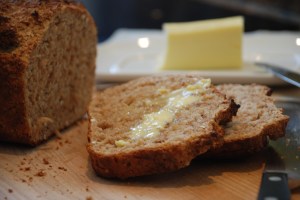
DSC_0346In our home there is almost always a loaf of scratch-made bread in the bread box.

It’s not the fancy white loaf that’s taken hours to make and been left to rise in a warm spot. No. Our bread is the rich, traditional Irish kind that can be whipped up quickly, in one bowl, and takes about an hour to bake. It’s the one that’s always served alongside those delicious wholesome vegetable-based soups found in cafes and pubs around the country and the very same one my lovely mother-in-law would give her twelve children nearly every day for tea time (dinner), before the main course.

I go back and forth baking Soda bread , Brown bread {the recipe below), and a Multiseed brown bread {promise to post soon}. Initially, I only made soda bread because that’s what my mother-in-law taught me to make. Then I added the other two breads because of the extra ingredients {oat groats, bran, and wheat germ in today’s Brown bread and oat groats, bran, wheat germ, sesame, poppy, pumpkin and sunflower seeds in the Multiseed bread} which help to make it even more healthy. Now, it’s a weekly toss up as to what’s in the bread box.

DSC_0357Whichever you try, rest assured your home will smell glorious for the effort. When you take the loaf from the oven, you and your family will want a slice while it’s still hot. And when slathered in butter, and maybe even some homemade jam, you’ll enjoy the nutty flavour, crumbly texture that is only found in traditional Irish bread. Enjoy!

Irish Brown Bread

Makes One Loaf

Ingredients

1 1/2 cups/200g/6oz self-raising flour

2 1/4 cups/300g/11oz coarse brown flour

1/3 cup/2 handfuls bran

1/4 cup/1 handful wheat germ

1/4 cup/2oz oat groats, pan toasted

2 heaped teaspoons baking powder

1 level teaspoon salt

2-3 cups/600-900ml/1-1 1/2 pints buttermilk

Directions

1. Pre-heat oven to 240°C/450°F/gas mark 9. Lightly oil a loaf tin on bottom and all sides and line with a sheet of parchment paper.

2. Mix all the dry ingredients together in a large bowl.

3. Add enough of the buttermilk to give a moist but not sloppy mixture.

4. Place in a loaf tin and bake for twenty minutes. Reduce oven temperature to 150C/300F/gas mark 2 and bake for an additional hour.

5. Ease bread from loaf tin. Carefully turn it over and tap to see if it sounds hollow. A hollow sound means the bread is fully cooked. If not, return it to the oven for another 10-15 minutes. Do not put it back into the loaf tin, just put it right-side up, directly on the shelf in the oven.

Related articles

Photo from Giada at Home Cookery BookLast week’s post on what Irish Catholics eat during Lent was a big hit. Seems there are quite a few of you out there who, like me, need a warm meat-free meal at the end of a Lenten week.

With that in mind, I offer you the following recipe for Pasta Ponza. It comes courtesy of the bright and beautiful Giada De Laurentiis and is found in her cookery book Giada at Home. You’ll forgive me for saying so but I turned instinctively to this particular chef after watching Pope Benedict XVI resign yesterday. The news from Rome and the beautiful images of Italy made me think Italian food seemed appropriate for this Friday’s Lenten Dinner Challenge. Giada herself was born in Italy but was then raised in Los Angeles. Stylistically, she reminds me of our own Rachel Allen.

This recipe is molto bene! Enjoy.

Pasta Ponza

Serves 4 to 6

Ingredients

Unsalted butter, for greasing

2 cups/12 oz red cherry or grape tomatoes, halved

2 cups/12 oz yellow cherry or grape tomatoes, halved

¼ cup capers, rinsed and drained

1 tablespoon olive oil, plus more for drizzling

½ teaspoon salt, or more to taste

¼ teaspoon freshly ground black pepper, or more to taste

½ cup/1oz Italian-style seasoned dried bread crumbs

1 pound/16oz ziti or other short tube-shaped pasta

1 ½ cups/8oz grated Pecorino Romano cheese

¼ cup chopped fresh flat leaf parsley leaves

Directions

1. Place an oven rack in the centre of the oven and preheat the oven to 375°F/190°C/gas mark 5. Butter an 8×8-inch baking dish. Set aside.

2. Combine the tomatoes, capers, olive oil, salt and pepper in the prepared baking dish. Toss to coat.

3. Sprinkle the bread crumbs over the tomato mixture. Drizzle the top with olive oil and bake for 30 to 35 minutes, until the top is golden. Cool for 5 minutes.

4. Meanwhile, bring a large pot of salted water to a boil over high heat. Add the pasta and cook, stirring occasionally, until tender but still firm to the bite, 8 to 10 minutes.

5. Drain the pasta, reserving about 1 cup of the pasta water. Transfer the pasta to a large serving bowl. Spoon the tomato mixture over the pasta. Add the cheese and toss well. If needed, thin out the sauce with a little pasta water. Season with salt and pepper, sprinkle with parsley, and serve immediately.

* Note: Photo was taken from Giada De Laurentiis’ cookery book Giada at Home.

Many of you have written in and asked, “What do the Irish eat during Lent?”.

The simple answer to that question is: “Pretty much what everyone else in the world eats during Lent.”

If you mean to ask, “What do Irish Catholics eat during Lent?”…well, that’s an entirely different question.

Catholics everywhere are meant to observe the Lenten tradition of giving something up. In Ireland most will abstain from eating sweets and puddings (dessert) or drinking alcohol. The exception, of course, is on St. Patrick’s Day when everyone gets a free pass to do as they please. I still don’t know how that came about but you know the saying “when in Rome…”. On Ash Wednesday, Good Friday and all Fridays during Lent, Catholics also observe the custom of not eating meat.

DSC_0376In our home, we typically eat fish once a week throughout the year. During Lent we eat it on Fridays. I tend to serve salmon because it’s a healthy protein, high in vitamin A and omega-3 fatty acids, which are essential for proper brain and heart function. My favourite places to buy salmon in Ireland are Caviston’s Food Emporium in Glasthule, Donnybrook Fair, and Marks & Spencer.

When it comes to recipes, Delia Smith’s roasted salmon fillet with a crusted pecorino and pesto topping is hard to beat. You may think pesto and salmon are an odd combination but the two together are just divine. As this is a dish I have been making for many years, I offer you the following three bits of advice: 1) supermarket pesto works better than homemade; 2) omitting the breadcrumbs from this recipe is fine; and 3) don’t substitute Parmesan cheese for Pecorino…it just doesn’t taste the same.

This simple salmon recipe is one I’m sure you’ll enjoy both during Lent and the whole year through.

Roasted Salmon Fillets with a Crusted Pecorino and Pesto Topping

Serves 4

Ingredients

4 x 5-6oz salmon fillets

2 rounded tablespoon finely grated Pecorino cheese

4 tablespoons fresh pesto sauce

squeeze of lemon juice

4 tablespoons fresh breadcrumbs

salt and freshly milled black pepper to taste

Directions

1. Pre-heat oven to 230°C/450°F/gas mark 8.

2. Begin by trimming the fillets if needed, and run your hand over the surface of the fish to check that there aren’t any stray bones lurking.

3. Now place the fish on a baking tray that’s been covered with foil or parchment paper.

4. Give each fillet a good squeeze of lemon juice and a seasoning of salt and pepper.

5. Give the pesto a good stir and measure 4 tablespoons into a small bowl, mix a third of the breadcrumbs with it to form a paste and spread over the salmon fillets.

6. Then, mix half the cheese with the remaining breadcrumbs and scatter this over the pesto. Then finish off with the remaining cheese.

7. Place the baking tray on the middle shelf of the oven and cook for 10-12 minutes, by which time the top should be golden brown and crispy and the salmon just cooked and moist.

8. Serve immediately with steamed new potatoes.

For more information about the Irish and Lent, please visit these websites: http://www.worldirish.com/story/22662-11-things-the-irish-will-give-up-for-lent-this-year

http://www.independent.ie/irish-news/instead-of-giving-up-for-lent-give-something-back-says-cardinal-29068738.html

I know we’re in the season of Lent and treats are supposed to be off the table for the coming weeks but when a friend phoned the other day to say she was going to call in (stop by), I had to make something  quick to serve with the tea.

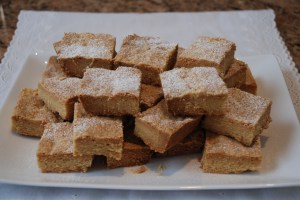
DSC_0310My saving grace was a yummy recipe for tray baked Irish Shortbread Biscuits found on the internet. It comes from Annaharvey Farm in Tullamore, County Offaly. I haven’t had the pleasure of staying at Annaharvey Farm or meeting proprietors Henry and Lynda Deverell yet but hopefully some day soon.

For those interested, Annaharvey Farm won the 2013 Georgina Campbell Award for Farmhouse of the Year. Henry and Lynda give the following five reasons why you should book a stay with them.

  • Cosy Farmhouse accommodation with great home cooked food.
  • Probably have the best riding school horses in the country available to clients.
  • Extensive cross country course over our 380 acre farm and woodland.
  • Enthusiastic and experienced instructors.
  • A warm welcome and a wonderful all round experience

If the welcome at Annaharvey Farm is as good as its shortbread, this is one guesthouse you ought not to miss!

Annaharvey Shortbread Biscuits

Makes 20-30

Ingredients

3 1/2 cups + 1 tablespoon/500g plain flour (if outside Ireland, use as All-Purpose flour)

2 1/3 cups/250g icing sugar (powdered sugar)

2 cups/250g corn flour (if outside Ireland, use Bob’s Red Mill Whole Grain Corn Flour)

2 cups + 2 tablespoons/500g melted butter

Directions

1. Preheat oven to 150°C/300°F/gas mark 2.

2. Sift all dry ingredients together.

3. Add melted butter and mix well.

4. Using your fingers, press the dough into a 9×13” or 10×15” baking tray or Swiss Roll tin.

5. Bake for 45-60 minutes. The biscuits should be a light golden colour on top.

6. Cut into squares while still hot and leave them to cool in the pan.

7. Sprinkle with a little sieved icing sugar before serving.

I know today is Valentine’s Day and everyone wants to think about Champagne and chocolates and fat little cupids hurling arrows of love across the sky. But today, behind the red hearts and the roses, there is an even greater opportunity to send your love across the world. Dance.

Yes, Dance.

Today, 14th February, women and men, girls and boys will come together in Ireland and around the world to dance for a cause.  It’s a campaign of LOVE and it’s called ONE BILLION RISING. If you are a woman, know a woman, are raising a woman, love a woman…you should know about it.

Have you heard of it?

The ONE BILLION RISING global day of action is a campaign created by award-winning American playwright and gender activist Eve Ensler and V-Day, the international movement she founded to stop violence against women and girls.

Today, it is hoped that as many as one billion people will ‘rise’. That they will walk out of their homes, their work places and their schools in an act of protest against the fact that one in three women – a total of one billion women – will be beaten or raped over the course of her life.

Eve is calling on people everywhere, on this day of love, to express their outrage, demand change, strike, dance, and rise in defiance of the injustices women suffer.

Ireland is answering the call.

The following are known Risings across Ireland:

  • Dublin: The Living Room, Clarendon Street, 1.00pm
  • Dublin: The Spire, O’Connell Street, 1.30pm
  • Dublin: Dáil Éireann, 2.15pm
  • Dublin: Trinity College Front Square, 3pm
  • Dublin:Connolly Station, 4pm
  • Dublin: Top of Grafton Street, 6pm
  • Donegal: In front of An Grianan Theatre 1.30pm, Main Street, Letterkenny
  • Mayo: Mayo Rising, 10.30pm, Lannagh Road, Castlebar
  • Sligo: Sligo: Sligo Rising, 6pm, Forthill, Sligo
  • Donegal: Get Donegal Dancing, 1.30pm, Main Street, Letterkenny
  • Sligo, Belta Country Market, lunchtime
  • Tipperary: Cloughjordan Rising, 8pm, Parochial Hall, Step Road, Cloughjordan
  • Galway: Galway is Rising, 1pm, Eyre Square
  • West Cork: West Cork Strike, Dance, Rise, 1.30pm, Wolfe Tone Square, Bantry
  • Maynooth: Start a Rising, 2pm, NUI Maynooth
  • Ennis: 5pm, Ennis Courthouse, Zumba parade down to the Queens
  • Kerry: Into the Light, 8pm, the Square, Listowel, Co Kerry
  • Tralee: 7 – 8pm, contact details of organisers here
  • Cork: 6.30pm, St Aloysius, Sharman Crawford St, Cork
  • Cork: 5pm, Ballydehob social club, Co Cork

Go out today and show your LOVE by DANCING! For a full list of events in Ireland, visit: http://www.onebillionrising.org/page/event/search_results?orderby=day&state&country=IE&limit=100&radius_unit=mi

And, for more Irish details, visit: http://www.facebook.com/VDayOneBillionRisingIreland and

http://www.thejournal.ie/one-billion-rising-ireland-dance-792602-Feb2013/

An Irish spring is always full of promise. The days are longer, daffodils dot the roadways with their bright yellow heads, ewes are birthing in fields not too far away, and there are several festive celebrations to carry us right up to summer. The first such event, Pancake Tuesday, takes place today.

IMG_3449Pancake Tuesday, also known in Ireland as Shrove Tuesday, is the Irish version of the widely known Fat Tuesday. It falls just before Ash Wednesday and marks the beginning of the Lenten season for Christians.

As with most things Irish, I learned of Pancake Tuesday from my lovely in-laws. My mother in law and sister-in-law make the lightest of pancakes and serve them up with a squeeze of lemon and a sprinkling of caster sugar. The recipe offered below is simply delicious and the one we follow in our Irish Home.

The custom of making pancakes, which actually resemble French crêpes, stems from the days when an Irish homemaker would rid her larder of eggs, sugar, butter and other dairy products so her family could fast for forty-plus days without temptation. Today Pancake Tuesday is less about theology and more about fun.

Known in Irish as Máirt na hInide, you’re sure to enjoy this sometimes-savoury, sometimes-sweet tradition in your home as much as we do in ours.

Simple Irish Pancakes

Serves Four

Ingredients

1 cup/120gm plain flour (self-raising flour)

Pinch of salt

2 large eggs, lightly beaten

8oz/200ml milk

1/3 cup/75ml water

4 tablespoons/2oz butter, melted

Directions

1. Sift the flour and salt into a medium size mixing bowl.

2. Make a well in the centre of the flour and the add eggs.

3. Add the milk and the butter and whisk.

4. Slowly add the water and continue to whisk until you have a thin batter that is free of lumps.

5. Melt some butter in a warm pan and, when bubbling, add a ladle of batter to the pan. Picking up your pan carefully, tilt it in a circular motion to spread the batter around.

6. Return your pan to the heat and allow the pancake to set. When lightly toasted, flip the pancake and allow the second side to turn a golden colour.

7. Remove from heat and cover with cling film (plastic wrap) until the batter is cooked up. Serve immediately, if possible, with one of the following fillings:

Sweet:

Lemon juice and caster sugar

Jam

Nutella

Stewed fruit

Bananas with toffee

Lemon curd

Cream and maple syrup

Savoury:

Chopped ham

Grated or crumbled cheese

Shredded salmon with capers and red onion

Spinach, bacon and mushroom

For more information about Irish pancakes and the Irish tradition of Pancake Tuesday, please visit these websites http://www.joe.ie/home/dumb-it-down/what-is-pancake-tuesday-noseriously-0021257-1

http://www.irishamericanmom.com/2012/02/19/irish-pancakes-for-shrove-tuesday/

http://marriedanirishfarmer.com/2011/03/08/fionns-sweet-carrot-pancakes/